“Software engineering is not just about creating something new—it’s about continuously evolving what already exists.”
In recent years, AI-driven coding assistants—most notably GitHub Copilot and its counterparts—have made a significant impact on the software development landscape. These tools are praised for helping developers write code faster and with less effort. However, their capabilities are still limited to a narrow portion of the development process. At CodeVista, we believe it’s time to think beyond mere code generation. Our vision focuses on the full software lifecycle, with an emphasis on the often-overlooked challenge of software evolution.
Understanding Where AI Coding Agents Excel—and Where They Fall Short
Let’s face an uncomfortable truth
Despite the hype surrounding AI tools, today’s coding assistants excel primarily in one narrow area—the implementation phase. These tools can quickly generate functions, classes, and boilerplate structures based on simple prompts. They can autocomplete code snippets and even offer suggestions for new features.
But when we widen the lens to look at the full scope of software development, it becomes clear that the effort spent on implementation is relatively small.
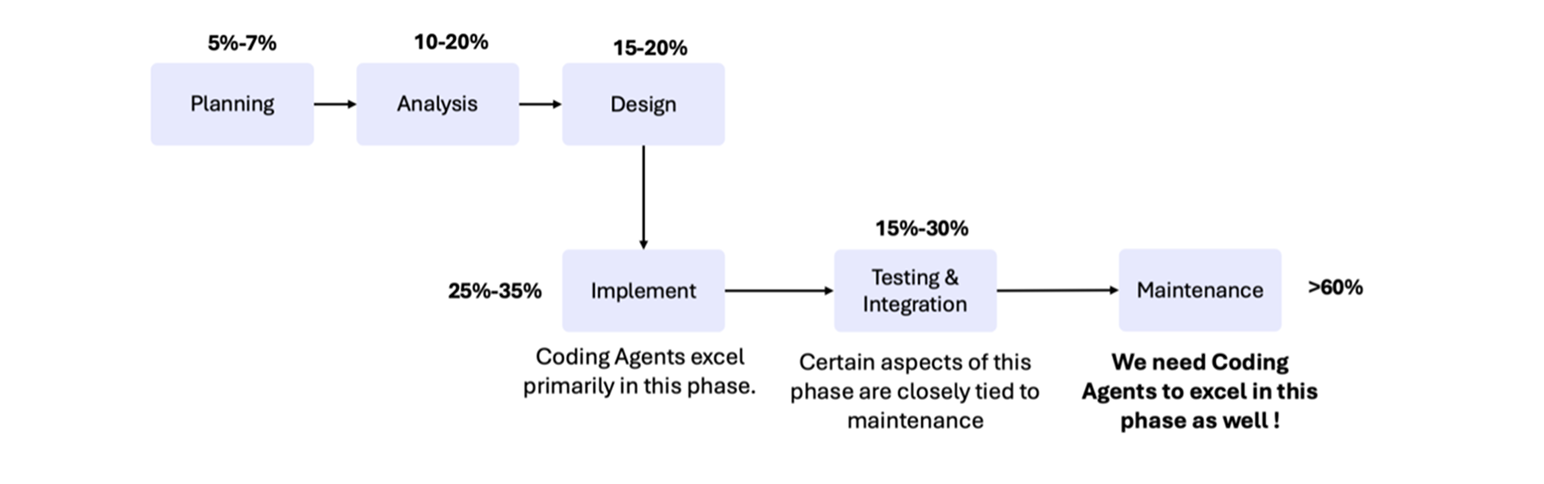
Industry data reveals that over 60% of engineering time is consumed by maintenance tasks—fixing bugs, responding to user feedback, adapting to new requirements, refactoring
legacy systems, and ensuring long-term system stability. While this phase might not be glamorous, it’s where the real work of software engineering takes place.
🤖 Today’s AI Agents: Mostly Useful in Implementation
- You write a prompt, and the assistant generates code.
- You ask it to autocomplete a function, and it responds instantly.
- You request a boilerplate structure, and it delivers on cue.
- Understanding a 5-year-old, unfamiliar codebase.
- Identifying the cascading effects of a bug fix across 20 different files.
- Suggesting safe architectural changes.
- Running an impact analysis to predict how a design modification might affect the broader system.
It struggles—if it can do it at all
Software Development is a Continuous Evolution Loop
To understand why these limitations are problematic, we must shift our perspective on software engineering. It is not simply a series of linear phases from planning to release. Instead, it’s a continuous loop of evolution.
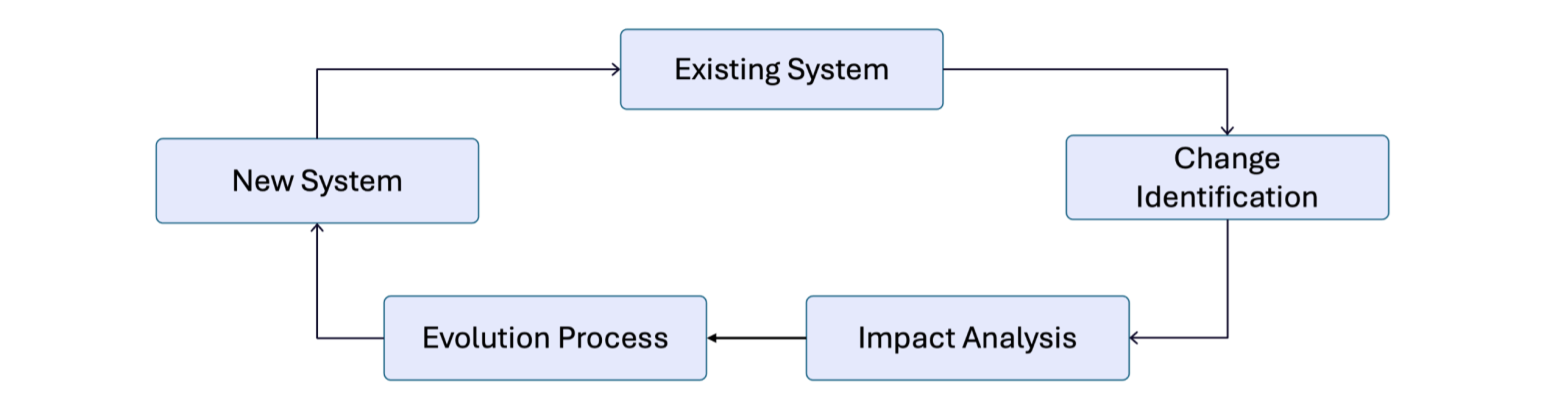
The process of software development resembles this cycle:
- Existing System: A working product in production.
- Change Identification: A bug is reported, or a new requirement emerges.
- Impact Analysis: Which parts of the system will be affected by the change?
- Evolution Process: Refactoring, development, testing, and updating.
- New System: An evolved version of the original product.
- The cycle repeats, with the "new system" becoming the next "existing system."
This loop is perpetual. As systems grow in complexity, the cost and risk associated with change increase—especially when intelligent support is lacking.
The Vision of CodeVista: Agents That Understand and Evolve Codebases
At CodeVista, we are building the next generation of AI-driven coding agents—not just copilots, but true collaborators. Our belief is simple:
💡 True developer productivity comes from intelligent support across the entire lifecycle—not just in writing code, but in reading, understanding, modifying, and evolving it.
- Understand large, existing codebases at the repository level.
- Provide semantic navigation and summarization to help developers onboard more quickly.
- Conduct code-aware impact analysis before any changes are made.
- Assist in test generation and validation to ensure new changes don’t break existing functionality.
- Offer valuable support during maintenance and refactoring—not just new development.
Why This Matters: Sustainability in Software Engineering
The term “sustainability” is often associated with environmental concerns, but it’s equally important in software engineering.
- Easy to understand.
- Safe to modify.
- Well-tested and well-maintained.
- Resilient to change.
Unfortunately, current AI tools are not designed with sustainability in mind. They excel at generating new code but lack the capability to understand or manage the cost of change.
At CodeVista, we’re laser-focused on developing agents that evolve alongside your system, providing intelligent insights into the impact of changes—not just generating code in isolation.
What Does Software Evolution Actually Involve?
Let’s take a closer look at the everyday tasks software engineers tackle when evolving a codebase—and how CodeVista can make a difference:
| EVOLUTION TASK | DESCRIPTION |
|---|---|
| Continuous Feature Development | Implement new features without breaking the old, through dependency analysis and regression checks. |
| Upgrading Legacy Codebases | Identify deprecated APIs and guide necessary framework or library upgrades. |
| Codebase Migration Across Languages | Automate translations (e.g., COBOL → Java, Python → TypeScript) while preserving logic and intent. |
| Large-Scale Bug Detection & Repair | Localize faults across multiple files and recommend structured, testable fixes. |
| Automated Code Reviews & Quality Control | Enforce best practices, detect code smells, and identify security vulnerabilities early in the development process. |
These tasks are far from trivial—they require a deep understanding of the system’s structure, history, and context—something today’s copilots do not possess.
What the Future Looks Like with CodeVista
Imagine an AI-powered development tool that does more than simply autocomplete your code. Picture an assistant that:
- Alerts you when a change could break downstream logic.
- Suggests tests you might have forgotten to write.
- Explains the original intent behind a legacy module.
- Refactors your system incrementally, avoiding regression risks.
- Identifies architectural violations before they turn into costly technical debt.
That’s the future we’re working towards at CodeVista—a future where AI not only assists in writing code but also understands and supports the evolution of the software it helps build.
Final Thought: Evolution Is the Real Frontier
CodeVista is not here to replace developers—it’s here to evolve alongside them, empowering them to build better, more sustainable software.